Fundamental research on chaotic microlasers (1995 – Present)
1. Introduction
I began studying laser diodes with a chaotic cavity while visiting Prof.
Siegman’s group in the Edward L. Ginzton Laboratory at Stanford University
from November 1995 to February 1996 as a visiting scholar. After that,
I continued research on this topic, collaborating with researchers of Advanced
Telecommunications Research Institute International, Max-Planck Institute
for the Physics of Complex Systems, Purdue University, NTT Communication
Science Laboratories, and so on. Here, I will introduce our major results
on this research topic.
2. Lasing characteristics of laser diodes with quasi-stadium chaotic cavities
Considering the motion of a classical particle moving freely and bouncing
elastically in a stadium-shaped box, one finds closed periodic orbits like
those illustrated in Fig. 1(a). However, all of the periodic orbits are
unstable under perturbation, which means that the trajectory of the particle
changes from a regular (periodic) orbit to a chaotic trajectory, as shown
in Fig. 1(b), as soon as the particle strays slightly off the periodic
orbit due to a small perturbation. Accordingly, the motion of a classical
particle confined in a stadium-shaped box is chaotic in general. In quantum
mechanics, however, the probability for finding a particle in a box is
given by the square of the wavefunction. The connection between the classical
and quantum mechanics of such a particle is an interesting topic in the
research fields of classical and quantum chaos [1]. If one replaces the
box and the trajectories of the classical particle with a stadium-shaped
optical cavity and ray trajectories confined in the cavity, the correspondence
problem between the classical and quantum mechanics in the box can be replaced
with the problem of ray-wave correspondence in the optical cavity.
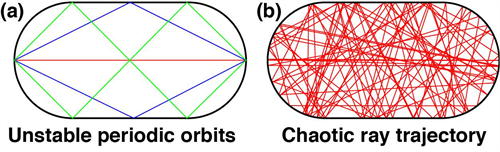
Fig. 1 Trajectories of a classical particle confined in a stadium-shaped
box.
Prof. Siegman’s group, which was interested in this problem at the time
of my visit, fabricated and tested laser diodes with quasi-stadium cavities,
as illustrated in Fig. 2. We measured the lasing characteristics of these
laser diodes and carried out numerical calculations for obtaining resonator
modes of the quasi-stadium optical cavity. Here, I introduce our experimental
and theoretical results [2,3].
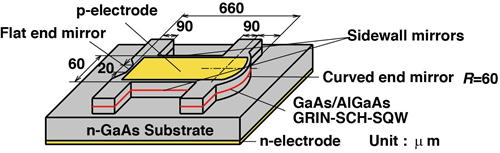
Fig. 2 Schematic illustration of laser diode with a quasi-stadium cavity.
Figure 3 shows the lasing characteristics of the quasi-stadium laser diode.
Clear build-up of the output power was confirmed from the light output
power vs. injection current characteristics, and a sharp peak appeared
in the lasing spectrum (see figure insets). The images on the right-hand
side of the figure show the output beam pattern observed using a lens and
CCD camera. The numerical values shown in the images correspond to the
distance from the output end mirror facets. Although fine interference
patterns were observed, the output beams emitted from the flat end mirror
split into three directions. In contrast, the output beams emitted from
the curved end mirror first focus to three spots, and then diverge again
and produce fine interference patterns.
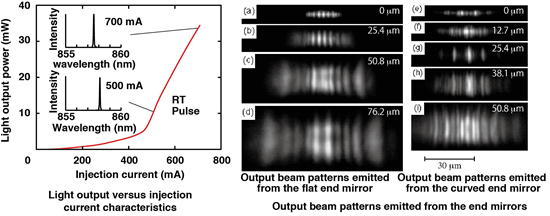
Fig. 3 Lasing characteristics of laser diode with a quasi-stadium cavity.
To explain the observed output beam patterns, we calculated the lowest-loss
resonator mode in the quasi-stadium cavity using an extended version of
the Fox-Li mode calculation method. Figure 4 shows the output beam patterns
emitted from the output mirror facets for the lowest-loss resonator mode.
The calculated output beam patterns well reproduced the experimental results.
We also calculated the beam propagation behavior inside the cavity and
found that the optical beams are localized on unstable periodic orbits.
The wavefunction localized on unstable periodic orbits in stadium-shaped
boxes (called “scar modes ” in the research field of quantum chaos) was
obtained from our numerical calculations. The similarities between resonator
and scar modes are interesting from the viewpoint of fundamental physics
[3].
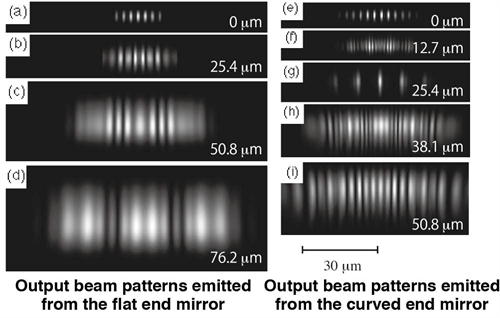
Fig. 4 Calculated output beam patterns emitted from the end mirrors.
The calculation results introduced here are published in the OSA’s open
access online journal [3]. In this article, one can watch short animations of beam propagation
from the end mirrors. Moreover, these results were introduced in Prof.
Siegman’s review article “Laser Beams and Resonators: Beyond the 1960s
” published in the millennium issue of the Journal of Selected Topics in
Quantum Electronics [4].
3. Lasing characteristics of laser diodes with stadium-shaped cavity
The quasi-stadium laser diode shown in Fig. 2 is somewhat special. The
lasing characteristics of the stadium-shaped cavity shown in Fig. 1 are
interesting from the viewpoint of fundamental physics.
We investigated the lasing characteristics of laser diodes with the stadium-shaped
cavity shown in Fig. 5, in collaboration with Advanced Telecommunications
Research Institute International [5]. The laser diodes were partially fabricated by NTT Advanced Technology
Corporation. Figure 6 shows the lasing characteristics of the laser diode.
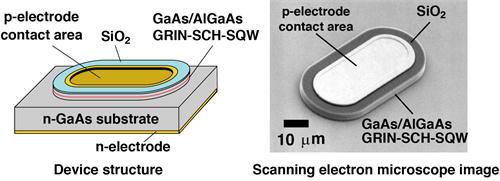
Fig. 5 Laser diode with stadium-shaped cavity.
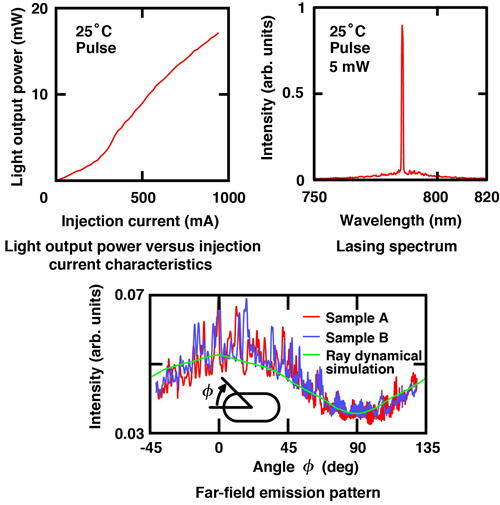
Fig. 6 Lasing characteristics of laser diode with stadium-shaped cavity.
Samples A and B show the experimental results for two different samples
fabricated on the same epitaxial wafer.
The threshold current of the laser diode is approximately 200 mA, above
which a sharp peak appears in the lasing spectrum. The light emission in
the long-axis direction is enhanced and the light emission in the short-axis
direction becomes weak. Although the far-field emission pattern contains
complicated interference patterns, the envelope of the far-field emission
pattern agrees with the ray dynamical simulation very well.
These experimental results were reported in our invited paper published
in the issue of the IEEE Journal of Selected Topics in Quantum Electronic
on Nonlinear Optics [5]. To the best of our knowledge, this was the first report on the lasing
of a stadium-shaped laser. Since then, the lasing characteristics of stadium-shaped
lasers with different materials, cavity sizes, and excitation techniques
have been reported [6,7,8].
4. Observation of the chaos-assisted tunneling using a chaotic cavity[9]
Although this work was organized by Dr. Shinohara of the Max-Planck Institute
(Currently at Waseda University), I will briefly introduce our experimental
results here, because this work has attracted considerable attention in
the research field of quantum chaos.
The egg-shaped cavity shown in Fig. 7 supports two types of ray trajectories:
the regular ray trajectories (blue line) in the vicinity of the rectangular
stable periodic orbit (red line) shown in Fig. 7(a), and the chaotic ray
trajectories (blue line) shown in Fig. 7(b). The optical rays that slightly
deviate from the rectangular stable periodic orbit propagate in the vicinity
of the stable periodic orbit, as illustrated by the blue lines in Fig.
7(a), and never convert to chaotic ray trajectories. In the same manner,
the chaotic ray trajectories never convert to regular ray trajectories.
This means that, in the case of ray dynamics, the regular ray trajectories
in the vicinity of the stable periodic orbit and the chaotic ray trajectories
are independent from one another. However, when considering wave propagation,
a small amount of energy of the light propagating along the stable periodic
orbit can be transferred to that of the chaotic ray trajectories. This
phenomenon is called chaos-assisted tunneling.
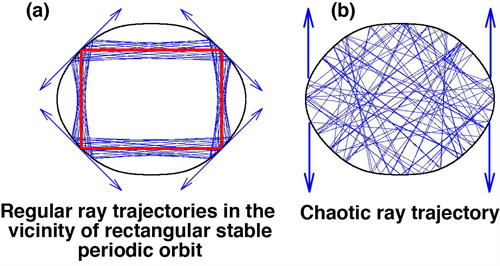
Fig. 7 Ray trajectories confined in the egg-shaped cavity.
We confirmed the existence of chaos-assisted tunneling in the egg-shaped
cavity. In particular, we prepared laser diodes with the egg-shaped cavity
shown in Fig. 7 and excited the resonator mode corresponding to the rectangular
stable periodic orbit selectively using an electrode contact formed along
the stable periodic orbit. Then, the far-field emission pattern from the
laser diode was observed. The optical beam propagating along the stable
periodic orbit is totally reflected at the cavity edges and confined in
the cavity, because the incident angle of the optical beam is much larger
than the critical angle. In this case, if chaos-assisted tunneling does
not occur, it is expected that only the evanescent wave formed outside
the cavity edge near the reflection points is emitted slightly in the tangential
directions (±45o and ±135ofrom the horizontal axis) of the cavity edge, as indicated by the blue
arrows in Fig. 7(a). In contrast, if chaos-assisted tunneling occurs, it
is expected that a portion of the energy propagating along the rectangular
stable periodic orbit will transfer to the chaotic trajectories and spread
in the cavity. The light following the chaotic trajectories eventually
breaks the condition of total internal reflection and is emitted from the
cavity edges. Our calculations show that the light is mainly emitted in
the directions ±90o from the horizontal axis, as indicated by the blue arrows in Fig. 7(b).
Accordingly, one can confirm the presence or absence of chaos-assisted
tunneling by observing the far-field emission pattern of the laser diode.
Figure 8 shows a scanning electron microscope image of the fabricated
laser diode and the observed far-field emission pattern. The laser diode
has an electrode contact along the rectangular stable periodic orbit to
excite the resonator modes corresponding to the periodic orbit. We confirmed
that the lasing spectrum exhibits equidistant peaks whose spacing agrees
very well with that estimated from the path length of the rectangular stable
periodic orbit. The observed far-field emission pattern exhibits two broad
peaks around ±90o. Therefore, we concluded that chaos-assisted tunneling occurs in the egg-shaped
cavity.
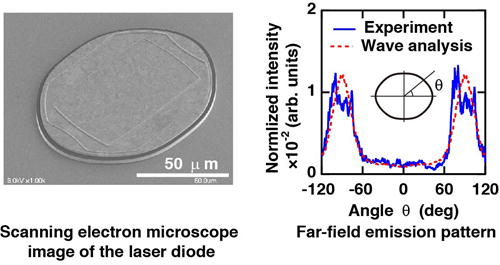
Fig. 8 Scanning electron microscope image of laser diode with an egg-shaped
cavity and its far-field emission pattern.
This work was introduced in Prof. Stone’s review article “Chaotic Billiard
Lasers ” published in Nature in the News & Views Section in 2010 [10].
Acknowledgements
I would like to thank the late Prof. A. E. Siegman of Stanford University
as well as Dr. C. G. Fanning, Dr. Y. Cheng, Dr. Y. Sun, and Dr. S. A. Biellak
of the Siegman laboratory, for giving me the opportunity to begin researching
chaotic cavity lasers in the early stage of my career. I also want to thank
my long-term collaborators, Dr. S. Shinohara of NTT Communication Science
Laboratories, Prof. T. Harayama of Waseda University, and Prof. S. Sunada
of Kanazawa University, and my collaborators in select research topics,
Prof. E. E. Narimanov of Purdue University and Prof. J. Wiersig of Otto
von Guericke University at Magdeburg. Finally, I would like to thank all
contributors to this research at Advanced Telecommunications Research Institute
International, NTT Communication Science Laboratories, and NTT Advanced
Technology Corporation.
References
[1] M. C. Gutzwiller, Chaos in classical and quantum mechanics, Springer
Verlag, New York, 1990.
[2] T. Fukushima, S. A. Biellak, Y. Sun, C. G. Fanning, Y. Cheng, S. S.
Wong, and A. E. Siegman, Lasing characteristics of a quasi-stadium laser
diode, Conference on Laser and Electro-Optics (CLEO’97) OSA Technical digest
(Optical Society of America), paper CWF6, 1997.
[3] T. Fukushima, S. A. Biellak, Y. Sun, and A. E. Siegman, Beam propagation
behavior in a quasi-stadium laser diode, Optics Express, vol. 2, no. 2,
pp. 21-28, 1998.
[4] A. E. Siegman, Laser beam and resonators: Beyond the 1960s, IEEE Journal
of Selected Topics in Quantum Electronics, vol. 6, no. 6, pp. 1389-1399,
2000.
[5] T. Fukushima and T. Harayama, Stadium and quasi-stadium laser diodes,
IEEE Journal of Selected Topics in Quantum Electronics, vol. 10, no. 5,
pp. 1039-1051, 2004.
[6] M. Lebental, J. S. Lauret, R. Hierle and J. Zyss, Highly directional
stadium-shaped polymer microlasers, Applied Physics Letters, vol. 88, no.
3, pp. 031108, 2006.
[7] W. Fang, H. Cao, and G. S. Solomon, Control of lasing in fully chaotic
open microcavities by tailoring the shape factor, Applied Physics Letters,
vol. 90, no. 8, 081108, 2007.
[8] H.-G. Park, F. Qian, C. J. Barrelet, and Y. Li, Microstadium single-nanowire
laser, Applied Physics Letters, vol. 91, no. 25, 251115, 2007.
[9] S. Shinohara, T. Harayama, T. Fukushima, M. Hentschel, T. Sasaki, and
E. E. Narimanov, Chaos-assisted directional light emission from microcavity
lasers, Physical Review Letters, vol. 104, no. 16, 163902, 2010.
[10] A. D. Stone, Chaotic billiard lasers, Nature, vol. 465, no. 7299,
pp. 696-697, 2010.