Selective excitation of resonator modes in two-dimensional laser cavities (2000 – Present)
1. Introduction
We are developing laser diodes with quasi-stadium cavities, which were
pioneered by Prof. Siegaman’s group at Stanford University[1,2] (see introduction to our research on laser diodes with chaotic cavities). In particular, we have designed laser diodes with quasi-stadium cavities
supporting a few stable periodic orbits and have proposed methods to excite
resonator modes corresponding to each periodic orbit selectively. Moreover,
we are applying the selective excitation method to functional laser diodes
with beam and polarization switching functionalities. Here, I will briefly
introduce our research on selective excitation.
2. Selective excitation of spatial modes in laser diodes with quasi-stadium
cavities
Figure 1 shows the major ray trajectories confined in a quasi-stadium
cavity, which consists of two curved end mirrors and two long straight
sidewall mirrors. A wide variety of ray trajectories appear in the cavity,
even though it has a simple geometry. The cavity is referred to as “quasi-stadium
” for the following two reasons: the curved end mirrors are not perfectly
half-circle, and the cavity length is much longer than the cavity width.
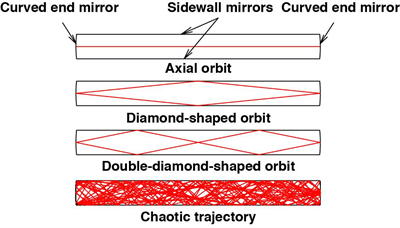
Fig. 1 Ray trajectories confined in the quasi-stadium cavity.
In this work, we developed a method to excite beam propagation modes along
the axial and diamond-shaped orbits [3,4,5], referred to as axial modes and diamond-shaped modes, respectively. First,
we employed the cavity shape shown in Fig. 2 to exclude ray trajectories
except for the axial and diamond-shaped orbits. The cavity has four open
corner regions connected to absorption regions; the optical light that
enters the absorption regions cannot return to the cavity. Second, we set
the cavity length, L, the radius of the curved end mirrors, R, and the cavity width, W, to 600 μm, 600 μm, and 60 μm, respectively, so that the axial and diamond-shaped
ray orbits are stable under perturbation. This means that the ray propagates
in the vicinity of the periodic orbits even if it strays off the periodic
orbits slightly. Third, we employed a GaAs/AlGaAs graded-index separate-confinement-heterostructure
single quantum well as the active layer to excite the resonator modes.
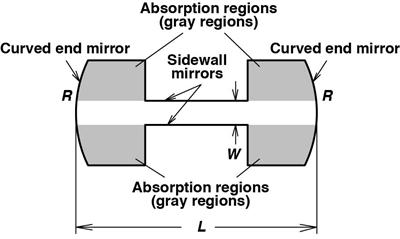
Fig. 2 Quasi-stadium cavity in which unwanted ray trajectories are excluded.
Figure 3 shows the far-field emission patterns for the laser diodes with
electrode contacts along the axial and diamond-shaped orbits [3]. The laser diode with the axial electrode exhibits directional emission
along the cavity axis. On the other hand, the laser diode with the diamond-shaped
electrode exhibits highly directional emissions corresponding to the diamond-shaped
periodic orbit (±19o). Accordingly, we concluded that the axial and diamond-shaped modes can
be selectively excited using electrode contacts with adequate geometries.
However, the beam patterns shown in Fig. 3 are degraded, i.e., each beam
produces multiple peaks in the far-field emission patterns. We considered
that the degradation of the output beams was caused by the lasing of higher
order modes based on mode analysis using the extended Fox-Li mode calculation
method [3].
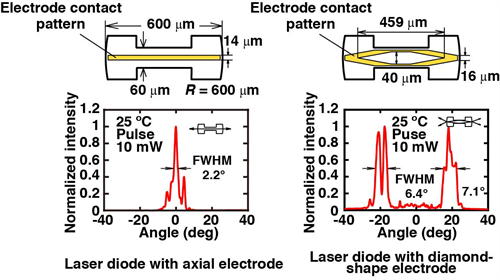
Fig. 3 Far-field emission patterns of quasi-stadium laser diodes with electrode
contacts along the axial and diamond-shaped orbits.
To obtain good beam mode with a single peak, it is important to suppress
the lasing of higher order modes. The beam widths of the higher order modes
are larger than that of the lowest order mode. We proposed and demonstrated
two approaches: one is reducing the electrode contact width to suppress
the modal gain for the higher order modes and the other is reducing the
curved end mirror width to increase the diffraction loss for the higher
order modes.
Figure 4 shows the far-field emission patterns of the quasi-stadium laser
diodes with axial and diamond-shaped electrode contacts with 2-μm width
[4]. Lasing of the higher order modes is suppressed and single peak output
beams are obtained. Figure 5 shows the far-field emission patterns of the
lowest order axial and diamond-shaped modes calculated using the extended
Fox-Li mode calculation method. The calculated far-field emission patterns
reproduce the experimental results shown in Fig. 4. Accordingly, we concluded
that the lowest order axial and diamond-shaped modes are excited selectively
[4].
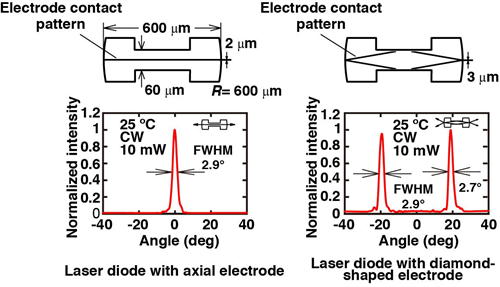
Fig. 4 Far-field emission patterns of the quasi-stadium laser diodes with small electrode contact width.
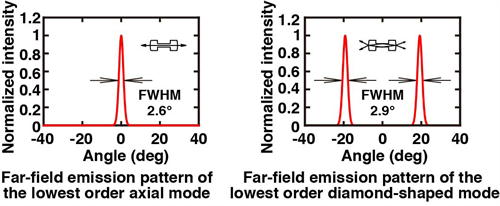
Fig. 5 Far-filed emission patterns of the lowest order modes calculated
using the extended Fox-Li mode calculation method.
Figure 6 shows the far-field emission patterns of a quasi-stadium laser
diode whose curved end mirror width is set to 20 μm [5]. We confirmed lasing occurs with the lowest order diamond-shaped modes
up to 20-mW output power.
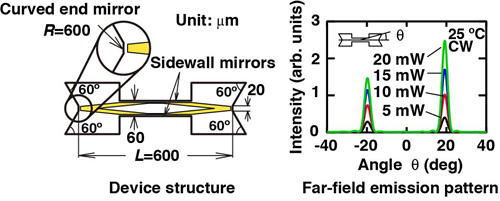
Fig. 6 Far-field emission patterns of the quasi-stadium laser diode whose
curved end mirror width is set to 20 μm.
Our experimental results show that desired spatial modes corresponding
to the stable periodic orbits in the quasi-stadium laser diode can be excited
selectively by appropriately designing the cavity shape and the electrode
contact pattern.
3. Potential applications of the selective excitation technique
We are studying applications of the selective excitation technique to
functional optical devices. The quasi-stadium cavity has axial and diamond-shaped
modes that exhibit different far-field emission patterns, as shown in Fig.
5. Accordingly, one can expect switching operation of the output beams
by switching the lasing of these resonator modes. For this purpose, we
fabricated and tested multi-electrode quasi-stadium laser diodes that have
a short axial electrode in the diamond-shaped electrode, as shown in Fig.
7 [6]. Figure 8 shows the far-field emission patterns of the laser diode for
the cases of current injection to the axial and diamond-shaped electrodes,
respectively. We confirmed that the axial modes are excited when the current
is injected to the axial electrode, while the diamond-shaped modes are
excited when the current is injected to the diamond-shaped electrode. Although
single-peak output beams were obtained under low power operations of 5
mW, the output beam patterns are degraded at output powers of 10 mW and
15 mW. For this device, we unfortunately employed a concentric resonator
design (L=2R), as shown in Fig. 7. Under the concentric resonator condition, the beam
width at the curved end mirror is enlarged; however, intense focus spots
are formed at the beam waist. The degradation of the output beams may be
caused by a nonlinear effect at the beam waist [7]. This problem will be solved by employing a confocal resonator design
(L=R), as shown in Fig. 6.
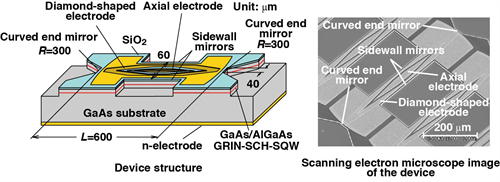
Fig. 7 Schematic illustration and scanning electron microscope image of
the multi-electrode quasi-stadium laser diode.
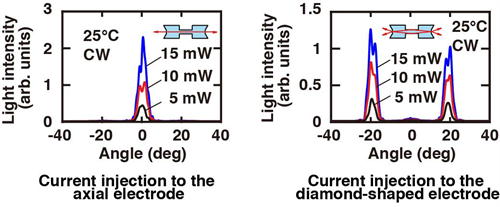
Fig. 8 Far-field emission patterns for the multi-electrode quasi-stadium
laser diode.
Laser diodes with an unstrained quantum well active layer usually lase
with transverse electric (TE) polarization modes, because the modal gain
for the TE polarized mode is larger than that for the transverse magnetic
(TM) polarized mode due to the selection rule of the optical transition
in the quantum well. Recently, we observed lasing with the TM polarized
modes in laser diodes with another two-dimensional cavity shape by setting
the incident angle of the diamond-shaped ray orbit to near Brewster’s angle
[8]. Accordingly, one can expect not only the beam switching but also polarization
switching functionality by setting the incident angle of the diamond-shaped
ray orbit at the curved end mirrors to Brewster’s angle for the multi-electrode
quasi-stadium laser diode shown in Fig. 7. Laser diodes with beam and polarization
switching functionality are an interesting application of the selective
spatial mode excitation technique.
Other potential applications such as fast physical random bit generators
and compact phonic integrated laser chaos devices have been proposed [9,10]. Moreover, compact laser gyroscopes employing laser diodes with two-dimensional
optical cavities are expected, and cavity optimization has been demonstrated
for such devices [11]. For these devices, the ability to selectively excite desired resonator
modes is essential. The two-dimensional microcavity laser diodes and selective
excitation techniques described are interesting not only from the viewpoint
of fundamental physics but also from the viewpoint of potential applications.
Acknowledgements
I would like to thank the late Prof. A. E. Siegman of Stanford University
for giving me the opportunity to begin my research on quasi-stadium laser
diodes. I also want to thank my collaborators Dr. S. Shinohara of NTT Communication
Science Laboratories, Prof. T. Harayama of Waseda Uiversity, and Prof.
S. Sunada of Kanazawa University. The work was partially supported by a
Grant-in-Aid for Young Scientists (B) provided by the Ministry of Education,
Science, Sports and Culture. Finally, I thank everyone in Advanced Telecommunications
Research Institute International, NTT Communication Science Laboratories,
and NTT Advanced Technology Corporation who contributed to this research.
References
[1] T. Fukushima, S. A. Biellak, Y. Sun, C. G. Fanning, Y. Cheng, S. S.
Wong, and A. E. Siegman, Lasing characteristics of a quasi-stadium laser
diode, Conference on Laser and Electro-Optics (CLEO’97) OSA Technical digest
(Optical Society of America), paper CWF6, 1997.
[2] T. Fukushima, S. A. Biellak, Y. Sun, and A. E. Siegman, Beam propagation
behavior in a quasi-stadium laser diode, Optics Express, vol. 2, no. 2,
pp. 21-28, 1998.
[3] T. Fukushima, T. Harayama, T. Miyasaka, and P. O. Vaccaro, Morphological
dependence of lasing modes in two-dimensional quasi-stadium laser diodes,
Journal of the Optical Society of America B, vol. 21, no. 5, pp. 935-943,
2004.
[4] T. Fukushima, S. Sunada, T. Harayama, K. Sakaguchi, and Y. Tokuda,
Lowest-order axial and ring mode lasing in confocal quasi-stadium laser
diodes, Applied Optics, vol. 51, no. 14, pp. 2515-2520, 2012.
[5] T. Fukushima, S. Shinohara, S. Sunada, T. Harayama, K. Arai, K. Sakaguchi,
and Y. Tokuda, Selective excitation of lowest-order transverse ring modes
in a quasi-stadium laser diode, Optics Letters, vol. 38, no. 20, pp. 4158-4161,
2013.
[6] T. Fukushima and T. Harayama, Axis and ring mode switching in multi-electrode
GaAs quasi-stadium laser diodes, CLEO/QELS and PhAST Technical Digest on
CD-ROM (The Optical Society of America, Washington, DC, 2007), Paper JWA127,
2007.
[7] T. Fukushima, Analysis of resonator eigenmodes in symmetric quasi-stadium
laser diodes, Journal of Lightwave Technology, vol. 18, no. 12, pp. 2208-2216,
2000.
[8] T. Fukushima, S. Shinohara, S. Sunada, T. Harayama, K. Sakaguchi, and
Y. Tokuda, Lasing of TM modes in a two-dimensional GaAs microlaser, Optics
Express, vol. 22, no. 10, pp. 11912-11917, 2014.
[9] S. Sunada, T. Fukushima, S. Shinohara, T. Harayama, K. Arai, and M.
Adachi, A compact chaotic laser device with a two-dimensional external
cavity structure, Applied Physics Letters, vol. 104, no. 24, 241105, 2014.
[10] S. Shinohara, S. Sunada, T. Fukushima, T. Harayama, K. Arai, and K.
Yoshimura, Efficient optical path folding by using multiple total internal
reflections in a microcavity, Applied Physics Letters, vol. 105, no. 15,
151111, 2014.
[11] S. Sunada and T. Harayama, Design of resonant microcavities: application
to optical gyroscopes, Optics Express, vol. 15, no. 24, pp. 16245-16254,
2007.